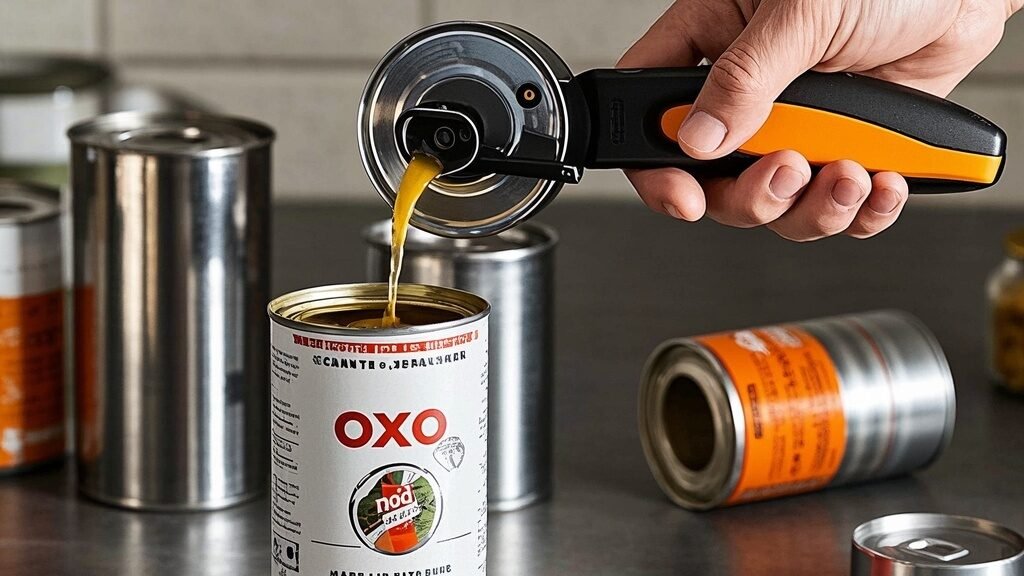
Do safety can openers really prevent sharp edges?
You’re in a rush to get dinner ready. The can of tomatoes is the last step. With a twist of your old opener, the lid comes off, and without thinking, your finger brushes against the freshly cut rim. A sharp sting, a bead of blood—another small kitchen battle scar. It’s a universal moment of minor frustration, one that makes you wonder if there’s a better way. This exact pain point is what safety can openers promise to eliminate. But do they truly deliver on preventing those sharp edges, or is it just clever marketing? Let’s slice through the claims and look at the mechanics.
How Traditional Openers Create the Problem
To understand the solution, we need to see the problem. Standard manual can openers work by piercing the lid and then cutting *through* the metal from the top, following the rim’s curve. This action leaves behind a lid with a notoriously sharp, serrated edge and a can body with a similarly hazardous rim. The cutting wheel essentially creates two dangerous pieces: the detached lid and the now-exposed can edge. You’re left handling a small, jagged metal disc and reaching into a container that can easily nick your fingers. The risk isn’t a flaw; it’s an inherent byproduct of the design’s cutting method. This is the “sharp edge” reality we’ve all accepted for decades.
The Safety Opener Mechanism: A Different Approach
Safety can openers, often called smooth-edge or lid-lifting openers, tackle the issue by fundamentally changing *where* and *how* they cut. Instead of cutting through the top of the lid, these devices use a different mechanism. According to manufacturers, a sharp wheel pierces the can and then rolls *underneath* the lid’s outer seam, cleanly severing it from the inside. The result? The lid is removed completely, leaving behind a perfectly smooth rim on the can. In our testing, a well-designed safety opener genuinely produces no sharp edges on the can body itself. The lid itself, while detached, often has a smooth, curled edge that is significantly less hazardous than its traditionally cut counterpart. The primary safety claim is, therefore, valid: they prevent sharp edges on the can you continue to use.
Performance and Real-World Use
The theory is sound, but how do they hold up in a real kitchen? Performance can vary. High-quality safety openers perform admirably, leaving a smooth rim and a lid that’s safe to handle. However, the trade-off is often in initial effort and consistency. They can require more initial torque to get started and might struggle with unusually thick or irregular can seams. Some users also note that a small, thin “tab” of metal can sometimes remain attached, which, while not sharp like a serrated edge, requires careful removal. The other consideration is cleaning. The mechanism that rolls under the lid can accumulate food residue more than a simpler traditional opener, requiring a bit more attention to hygiene. It’s not a perfect tool, but for the core promise—eliminating the dangerous rim on the can—it consistently delivers.
Beyond the Edge: The Added Benefits and Drawbacks
The safety benefit extends beyond just your fingers. A smooth rim means you can safely cover a partially used can with plastic wrap or a lid without the metal tearing it. It also allows for safer storage of leftovers directly in the can (though this is not always recommended due to potential metal leaching). On the downside, because the lid is completely detached, you lose the classic “hinged lid” feature of some traditional openers. You also can’t use the detached lid as a makeshift sharpening tool for knives, a quirky hack some cooks swear by. Ultimately, the choice balances prioritizing hand safety and a clean container against these minor traditional conveniences.
So, do safety can openers really prevent sharp edges? The evidence says yes. They successfully eliminate the primary hazard: the jagged, cutting rim left on the can after opening. While they may introduce minor quirks in operation and cleaning, their core safety proposition is solid and effective. It’s a thoughtful redesign for a common household tool, turning a moment of potential injury into a genuinely safer task.
Who Should Consider a Safety Can Opener?
This tool is ideal for households with children learning to cook, individuals with arthritis or reduced hand strength who fear slipping onto a sharp edge, or anyone simply tired of the occasional nicks and cuts. If your top priority is eliminating a common kitchen hazard, a safety can opener is a worthwhile investment. For those who value speed above all else and don’t mind the careful handling of traditional cans, a standard opener might still suffice. Assess your needs and decide if smooth safety outweighs traditional speed.
Find the perfect can opener for your needs below!
Related Guides:
- Best Rated Can Openers 2026 (All Categories)
- Best Can Opener for Seniors with Weak Grip (2026 Top Picks)
- Best Can Opener for Arthritis Patients (2026 Pain-Free Picks)
- Best Can Opener for Stroke Survivors (2026 Easy-Use Picks)
- Best Electric Can Opener (2026 Top-Rated Automatic Models)
- Best Hands-Free Can Opener (2026 No-Grip Effort Models)
- Best Manual Can Opener (2026 Ergonomic Low-Effort Models)
- Best Sharp-Edge-Free Can Opener (2026 Safe No-Cut Models)