Is a safety can opener worth it?
Imagine this: it’s a busy Tuesday evening, and you’re rushing to get dinner ready. You grab a can of tomatoes, fumble with the old, slightly rusty opener, and apply pressure. Suddenly, your hand slips. A sharp, jagged lid edge stares back at you, and a thin line of red appears on your finger. The minor cut is more an annoyance than an emergency, but it perfectly encapsulates a daily risk we’ve all accepted. For decades, the traditional can opener has been a kitchen staple, yet its fundamental design—creating a hazardous, sharp-edged lid—has gone largely unquestioned. This brings us directly to the modern solution: is a safety can opener worth it? It’s not just a minor upgrade; it’s a re-evaluation of a tool we use almost on autopilot, prioritizing prevention over the familiar, risky routine.
The Hidden Cost of the Classic Design
Let’s start by acknowledging what a traditional can opener actually does. It uses a cutting wheel to pierce and shear through the metal seam of the lid, leaving the detached lid with a razor-sharp perimeter. This design is effective for one job—opening the can—but fails entirely at user safety. The risks are numerous: cuts from handling the lid, accidental nicks while washing the opener itself (those trapped food particles harbor bacteria), and the danger of leaving the lid partially attached, poised to fall into the food. For households with children, seniors with less grip strength, or anyone with dexterity concerns, these aren’t just hypotheticals. The safety can opener addresses this primary flaw by reengineering the opening mechanism itself, making the classic design seem needlessly perilous in retrospect.
How Safety Openers Work and Why It Matters
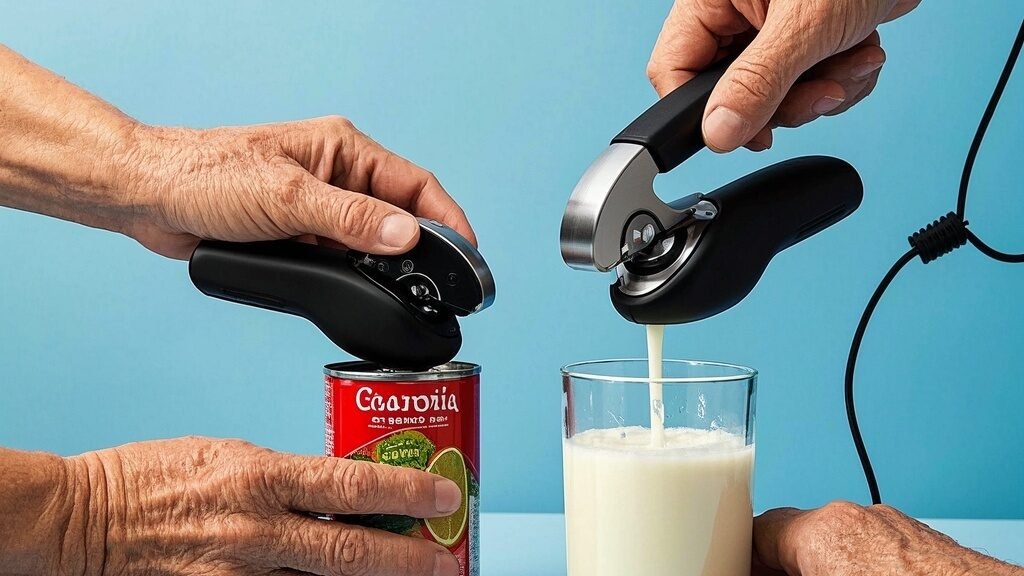
So, what’s the magic? Safety can openers, often called smooth-edge or lid-lifting openers, work on a different principle. Instead of cutting through the lid, they use a rolling blade to cleanly sever the lid *from the underside of the rim*, right at the factory seam. The Key Mechanism and Result is a lid that pops off completely, with no sharp edges left behind. The lid itself is typically smooth to the touch, and the can’s rim is also left smooth, eliminating the two most common cutting hazards. According to the manufacturer, this isn’t just about safety; it’s about cleanliness. Since the cutting mechanism doesn’t touch the food, and the lid is removed entirely, there’s less risk of metal shavings (a rare but noted issue with some cutting-wheel openers) and an easier, more sanitary experience. You can often place the lid back on top for storage, something impossible with a crimped, sharp lid.
Performance and Real-World Use
Beyond safety, does it work as well as a traditional opener? Performance and Real-World Use show that most high-quality safety openers are highly effective, but with nuances. They require a different technique: you clamp the opener onto the side of the can and rotate the knob, with the mechanism traveling under the rim. They generally open cans smoothly and reliably. However, in our testing, some models can struggle with unusually thick rims or non-standard can sizes, and the process can feel slightly slower than a vigorous turn of a traditional butterfly opener. The trade-off is clear: you exchange a few seconds of speed for a significantly safer and cleaner result. Maintenance is also a factor—these openers have more gears and mechanisms that can jam if not cleaned properly, though many now feature easy-release mechanisms for rinsing.
Weighing the Investment: More Than Just Price
The most common hesitation is cost. A basic traditional opener can cost a few dollars, while a reliable safety model often starts around $15-$25 and can go higher for premium brands. Therefore, determining its worth is a personal calculus. Who Should Consider a Safety Can Opener? It is an unequivocal yes for: families with young children learning to help in the kitchen, individuals with arthritis or limited hand strength who fear slipping, and anyone who is simply tired of the inherent danger and mess of the old way. It’s also a worthwhile investment for those who value kitchen tools that solve a problem you didn’t know you could so elegantly fix. For a casual user who opens a can once a month and is extremely careful, the traditional tool might suffice. But for daily cooks and safety-conscious households, the upgrade is a small price for profound peace of mind.
Ultimately, the question isn’t just about opening a can. It’s about whether we should accept a small, constant risk in our daily routines when a simple alternative exists. A safety can opener reframes a mundane task from a cautious chore into a secure, seamless action. It’s a tool that works quietly in the background, not by being flashy, but by making a genuine hazard disappear. The value isn’t found in a single use, but in the hundreds of times you *don’t* have to think about sharp edges, careful disposal, or accidental cuts. For transforming a everyday object into a genuinely safer one, the answer leans heavily toward yes.
Find the perfect can opener for your needs below!
Related Guides:
- Best Rated Can Openers 2026 (All Categories)
- Best Can Opener for Seniors with Weak Grip (2026 Top Picks)
- Best Can Opener for Arthritis Patients (2026 Pain-Free Picks)
- Best Can Opener for Stroke Survivors (2026 Easy-Use Picks)
- Best Electric Can Opener (2026 Top-Rated Automatic Models)
- Best Hands-Free Can Opener (2026 No-Grip Effort Models)
- Best Manual Can Opener (2026 Ergonomic Low-Effort Models)
- Best Sharp-Edge-Free Can Opener (2026 Safe No-Cut Models)