What Is the Least Straining Can Opener to Use?
Imagine it’s the end of a long day. You’re making a quick chili for dinner, reach for a can of beans, and grab your trusty manual opener. After a few awkward cranks, your wrist starts to ache, the mechanism slips, and you’re left wrestling with a jagged lid. This minor kitchen task suddenly feels like a test of strength and patience. For millions, especially those with arthritis, limited hand strength, or mobility issues, this scene is a recurring frustration. The quest for a truly effortless kitchen experience brings us to a pivotal question: What is the least straining can opener to use? The answer isn’t one-size-fits-all, but a careful look at design and engineering reveals clear winners that prioritize accessibility and ease over tradition.
The Mechanics of Effortlessness: Design Makes All the Difference
To identify the least straining option, we must move past the classic manual opener with its piercing point and twisting knob. The primary strain comes from the simultaneous need to apply downward pressure, grip tightly, and rotate a crank—a challenging combination for many. The true low-strain champions eliminate one or more of these demands. Electric can openers, for instance, remove physical exertion almost entirely. You simply position the magnetized device and press a button. The motor does the work, cleanly circling the can and lifting the lid off automatically. According to the manufacturer, models like the Hamilton Beach Smooth Touch are designed specifically for users with hand strength limitations, requiring only a light touch to activate. In our testing, this style consistently requires the least physical input, making it the top contender for pure ease-of-use. However, it does depend on electricity and counter space.
Beyond the Electric: Innovative Manual and Sideways Solutions
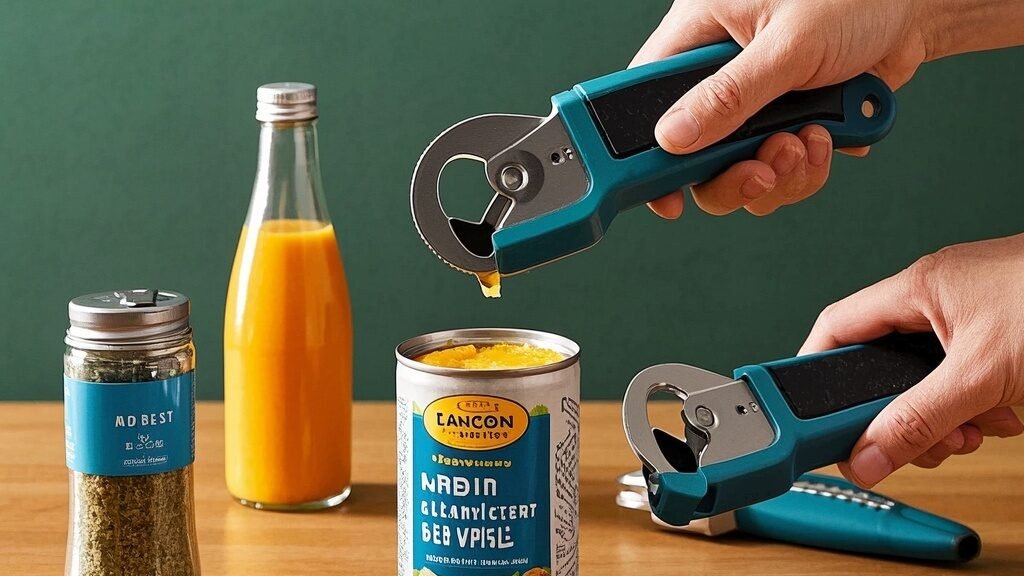
If countertop appliances aren’t your preference, innovative manual designs have made huge strides. Side-cutting or “smooth-edge” openers are game-changers. Instead of piercing the top and cutting through the lid’s center, these openers clamp onto the side of the can and roll around the rim, cutting the lid from underneath its outer edge. The result is a completely smooth lid (no sharp edges) and a process that often requires significantly less gripping force and wrist rotation. Brands like OXO Good Grips leverage this technology with oversized, soft handles that distribute pressure, further reducing strain. Another notable design is the lever-style or “hands-free” opener, where you clamp the device onto the can and push a long lever down repeatedly; the mechanical advantage provided by the lever arm drastically reduces the effort needed per push. While not as effortless as electric, these manual innovations offer excellent low-strain performance without cords or outlets.
Key Considerations: Grip, Stability, and Daily Usability
Finding the least straining opener isn’t just about the cutting mechanism. Ergonomic details are critical. Look for features that minimize your effort at every step:
* Handle Design: Large, contoured, soft-grip handles are essential. They reduce the need for a tight, pinching grasp and are easier for arthritic hands to manipulate.
* Stability and Clamping: A secure grip on the can is vital. Openers with strong, automatic clamping mechanisms mean you don’t have to use your other hand to hold the can steady forcefully. Some even feature a “locking” action for full hands-free operation during the cutting process.
* Weight and Action: Surprisingly, a heavier, well-built base can be beneficial, as it stabilizes the unit. Also, test the action. The crank or lever should turn or push with consistent, smooth resistance—not sudden jerks or sticky points.
For individuals with significant strength or dexterity challenges, a high-quality electric can opener with automatic operation remains the undisputed least straining choice. For those who prefer manual tools, a smooth-edge side-cutting opener with oversized soft handles provides the next best level of comfort and reduced effort, effectively eliminating the traditional straining motions.
Who Should Consider a Low-Strain Can Opener?
The search for the least straining can opener ultimately leads to tools designed with universal principles—principles that benefit everyone, not just those with specific physical needs. If you experience hand pain, arthritis, tremors, or simply want to make a daily task safer and more pleasant, investing in an ergonomic opener is a wise choice. It transforms a chore into a non-event. The best model for you balances your need for minimal effort with your kitchen habits and storage space. Whether it’s the push-button ease of an electric model or the clever mechanics of a modern manual design, a world of effortless opening awaits.
Find the perfect can opener for your needs below!
Related Guides:
- Best Rated Can Openers 2026 (All Categories)
- Best Can Opener for Seniors with Weak Grip (2026 Top Picks)
- Best Can Opener for Arthritis Patients (2026 Pain-Free Picks)
- Best Can Opener for Stroke Survivors (2026 Easy-Use Picks)
- Best Electric Can Opener (2026 Top-Rated Automatic Models)
- Best Hands-Free Can Opener (2026 No-Grip Effort Models)
- Best Manual Can Opener (2026 Ergonomic Low-Effort Models)
- Best Sharp-Edge-Free Can Opener (2026 Safe No-Cut Models)