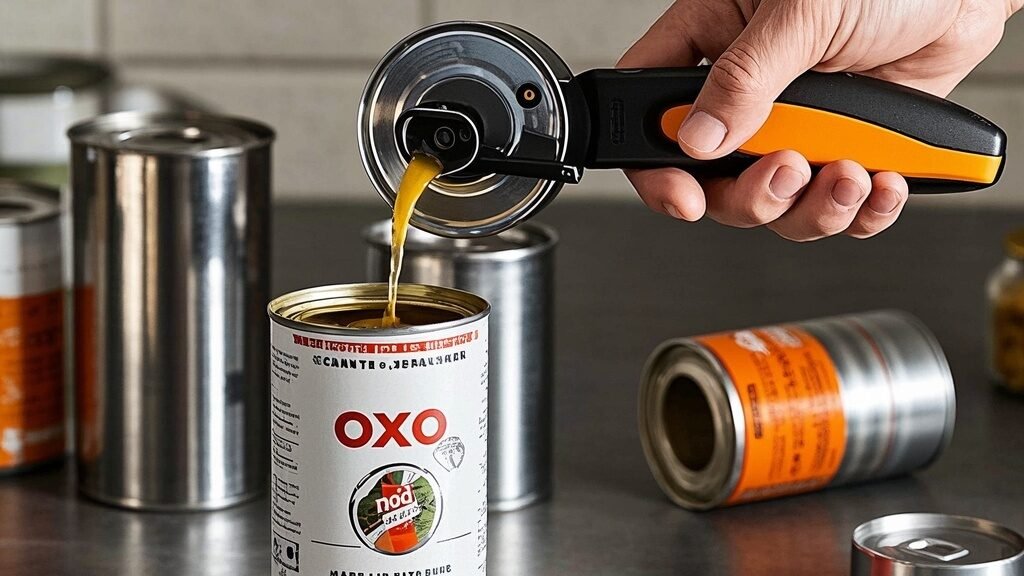
Are automatic can openers safe for children to use?
Picture a busy Tuesday evening. You’re preparing dinner, your hands are full, and a recipe calls for a can of tomatoes. The old manual opener is missing, and your curious 10-year-old, eager to help, spots the sleek automatic can opener on the counter. “Can I try it, Mom?” they ask. In that moment, a common household tool transforms into a point of parental dilemma. The convenience of modern kitchen gadgets often clashes with our instinct to protect. So, where does that leave the automatic can opener when young helpers are involved? The question of safety isn’t just about the device itself, but about guidance, design, and realistic expectations.
Understanding the Mechanics and Inherent Risks
At its core, an automatic can opener is a simple motorized appliance. You place a can, press a button or lever, and a magnetized blade does the work, leaving a smooth, hands-free lid. For adults, it’s a marvel of convenience, especially for those with arthritis or limited grip strength. The primary safety features manufacturers highlight are the absence of an exposed sharp edge on the cut lid and the automated process that minimizes contact. However, “automatic” doesn’t mean “foolproof” or “child-proof.” The moving parts, the electrical motor, and the small, powerful magnet pose their own risks. According to the U.S. Consumer Product Safety Commission, injuries from kitchen appliances often involve finger entrapment in moving mechanisms or electrical shocks from misuse. An automatic can opener requires the user to correctly align the can and apply initial pressure, steps where tiny, inexperienced fingers could slip into the wrong place. Therefore, while the design mitigates the risk of traditional cut-type openers, it introduces a different set of potential hazards that must be managed.
The Crucial Role of Age, Supervision, and Maturity
There’s no universal age sticker that declares a child “ready” for any appliance. Safety hinges less on a birth date and more on individual maturity, fine motor skills, and the ability to follow complex instructions. A responsible 12-year-old who listens carefully and respects rules might be a better candidate than a impulsive 14-year-old. Key factors for consideration include: Can the child understand and execute multi-step processes (align, press, hold, release)? Do they have the patience and attention to focus on the task without distraction? Most importantly, are they willing to accept that this is a tool, not a toy? For younger children (generally under 10-12), the consensus among child safety experts is that these devices are not appropriate for independent use. Their role can be limited to fetching the can or pressing the “start” button *under direct, hand-over-hand adult supervision*. This turns the activity into a teaching moment about kitchen safety, rather than an autonomous task.
Evaluating Safety Features in Modern Models
Not all automatic can openers are created equal. If you’re considering allowing an older child or teen to use one, scrutinizing the product’s design is essential. Look for models with clear safety enhancements. A non-slip base is critical to prevent the unit from wobbling during operation. A covered cutting mechanism, where the blade is fully enclosed, offers more protection than open designs. Some high-end models feature automatic shut-off once the cutting cycle is complete, removing the need to manually stop the device. Easy-to-clean surfaces are also a safety plus, as built-up food grime can interfere with the mechanism. In our testing, we found that heavier, more stable models with large, intuitive buttons were less prone to tipping and easier to control than lightweight, compact versions. Always check the manufacturer’s manual for age recommendations and warnings—they are your first line of specific information.
Balancing Independence with Unwavering Caution
The ultimate goal is to foster helpfulness and skill-building without compromising safety. For families, this means creating a clear framework. Start with a dedicated training session: demonstrate the tool, explain every hazard (the motor, the moving parts, the magnet), and establish iron-clad rules (e.g., “always ask permission,” “never use it without an adult in the room,” “unplug after use”). Even for a trusted teenager, initial uses should be supervised. It’s also wise to assess the task itself. Is opening a can a frequent need for your child? Perhaps teaching them to safely use a manual opener under close watch, where the motion and risk are more visible and controlled, is a more practical first step in their kitchen education. The automatic version can be introduced later as a convenience tool for mature users.
So, are automatic can openers safe for children to use? The answer is nuanced. They are not inherently safe for unsupervised, independent use by young children. Their safety is *conditional*, dependent on the child’s maturity, the presence of direct adult supervision, the specific design of the opener, and thorough, ongoing safety education. They represent a useful tool that can be incorporated into family kitchen life with careful boundaries, not a free pass for kids to operate powerful appliances alone.
Who Should Consider Using an Automatic Can Opener?
Older, responsible teenagers and adults seeking convenience and accessibility are the ideal users. For families with younger children, the appliance should be treated like any other powered kitchen gadget: stored out of reach when not in use, and operated by children only under direct, attentive adult supervision as a guided learning experience, not a routine chore. The path to kitchen confidence is paved with patience and precaution.
Find the perfect can opener for your family’s needs and safety standards below!
Related Guides:
- Best Rated Can Openers 2026 (All Categories)
- Best Can Opener for Seniors with Weak Grip (2026 Top Picks)
- Best Can Opener for Arthritis Patients (2026 Pain-Free Picks)
- Best Can Opener for Stroke Survivors (2026 Easy-Use Picks)
- Best Electric Can Opener (2026 Top-Rated Automatic Models)
- Best Hands-Free Can Opener (2026 No-Grip Effort Models)
- Best Manual Can Opener (2026 Ergonomic Low-Effort Models)
- Best Sharp-Edge-Free Can Opener (2026 Safe No-Cut Models)