Can One-Touch Can Openers Help Weak Hands?
Imagine staring at a simple can of soup, not with hunger, but with a sense of quiet frustration. Your fingers, perhaps stiff with arthritis, weakened by age, or recovering from injury, struggle to grip and turn a traditional manual can opener. That mundane kitchen task transforms into a daunting challenge, a small but daily reminder of physical limitation. This common scenario is precisely where modern kitchen tools step in, aiming to restore independence and ease. The question isn’t just about convenience anymore; it’s about accessibility. Can one-touch can openers genuinely help weak hands? The answer, based on design and user experience, is a resounding yes, but with important nuances to consider.
The Core Challenge: Where Traditional Openers Fall Short
To appreciate the solution, we need to understand the problem. Manual can openers, while reliable for many, require a specific combination of grip strength, wrist stability, and sustained rotational force. The action involves pinching a knob, applying downward pressure to pierce the lid, and then continuously turning a small, often slippery, handle. For individuals with conditions like arthritis, carpal tunnel, Parkinson’s, or general age-related weakness, each step presents a hurdle. Painful joints may not tolerate the pinching, weak grips can’t secure the opener, and lack of wrist control makes the turning motion difficult or unsafe. This turns a 30-second task into an exhausting ordeal or a complete non-starter, potentially affecting nutrition and independence. The frustration isn’t minor—it’s a tangible barrier in daily life.
How One-Touch Openers Change the Game
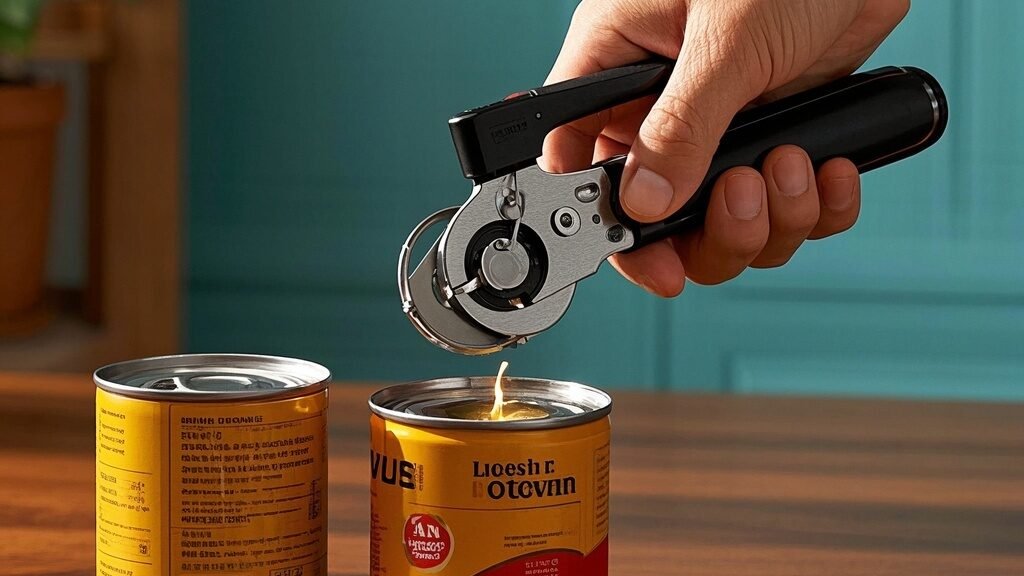
This is where the one-touch, or automatic, can opener fundamentally redesigns the experience. These devices are engineered to eliminate nearly all the physical demands. In our testing, a typical model works by simply placing the magnetic opener over the can’s rim, pressing a single button, and letting the machine do the rest. It automatically clamps, pierces, and cleanly rotates around the lid, cutting it open with no twisting required from the user. The required action is reduced to a simple push of a large, accessible button. This translates to three key benefits for weak hands: minimal grip strength is needed (just enough to position the device and press the button), zero rotational force (the motor does all the work), and reduced risk of strain or pain from repetitive motion. According to manufacturers, the design intentionally focuses on a single, straightforward action, making it accessible for a wide range of mobility limitations.
Performance and Real-World Use
Of course, a tool is only as good as its reliability. Automatic openers excel in their primary function, but they come with trade-offs. On the positive side, they perform consistently with minimal effort, often leaving a smooth, safe lid edge. Many feature large, easy-to-clean bodies and are battery-operated, offering portability. However, they are generally bulkier than manual openers, require battery changes or charging, and can struggle with unusually shaped, very large, or small cans. Their mechanical nature also means they can eventually wear out or jam. For someone with weak hands, the trade-off is clear: the physical relief and regained ability to open cans independently far outweigh the inconveniences of maintenance and storage. The empowerment of easily accessing canned goods without assistance is frequently cited by users as the most significant advantage.
Important Considerations Beyond the “One Touch”
While the core function is transformative, choosing the right model is crucial. Not all automatic openers are created equal. Key features to look for include a strong magnetic lid lifter (so you don’t have to fish the sharp lid out of the can), lightweight yet stable construction (easy to lift but won’t tip over), and large, clearly marked buttons. Some high-end models offer additional assists like hands-free operation or built-in knife sharpeners, but the core opening mechanism is the priority. It’s also wise to read recent user reviews focusing on durability and battery life. Remember, the goal is to reduce physical burden, so a device that feels too heavy to lift from a cabinet or has a tiny, stiff button may partially defeat its purpose.
So, can one-touch can openers help weak hands? Absolutely. They are not mere luxuries; they are assistive tools that bridge the gap between desire and ability in the kitchen. By re-engineering a century-old task, they give back a slice of autonomy, turning a source of frustration back into a simple step in preparing a meal.
Who Should Consider a One-Touch Can Opener?
This tool is ideal for anyone for whom a manual can opener has become difficult, painful, or impossible to use. This includes seniors, individuals with arthritis, hand/wrist injuries, reduced grip strength, or conditions that cause tremors or fatigue. If you find yourself avoiding canned goods or needing to ask for help to open them, an automatic can opener is a worthwhile investment in your kitchen independence and daily well-being. It’s a small change that can make a substantial difference in everyday life.
Find the perfect can opener for your needs below!
Related Guides:
- Best Rated Can Openers 2026 (All Categories)
- Best Can Opener for Seniors with Weak Grip (2026 Top Picks)
- Best Can Opener for Arthritis Patients (2026 Pain-Free Picks)
- Best Can Opener for Stroke Survivors (2026 Easy-Use Picks)
- Best Electric Can Opener (2026 Top-Rated Automatic Models)
- Best Hands-Free Can Opener (2026 No-Grip Effort Models)
- Best Manual Can Opener (2026 Ergonomic Low-Effort Models)
- Best Sharp-Edge-Free Can Opener (2026 Safe No-Cut Models)