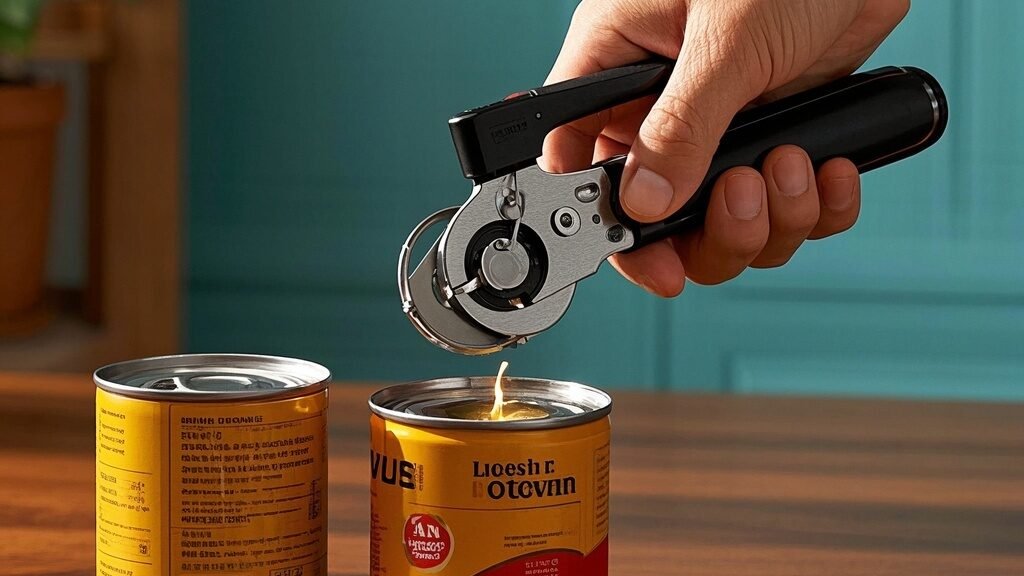
Can people with arthritis use manual can openers?
Picture this: it’s dinnertime, and a simple recipe calls for one can of tomatoes. You pull it from the pantry, grab your trusty manual can opener, and brace for the familiar struggle. Your hands, stiff and tender from arthritis, protest as you try to grip the small, cold handles and apply enough twisting force. What should be a 10-second task becomes a frustrating battle of will against pain and limited mobility. This everyday challenge leads many to wonder: Can people with arthritis use manual can openers? The honest answer is not a simple yes or no. While traditional manual models can be difficult, even impossible, for some, the landscape of kitchen tools has evolved. Success hinges on understanding your specific needs and identifying the innovative designs that transform this basic task from a painful chore into an achievable one.
The Challenge: Why Standard Manual Openers Fall Short
To understand the solution, we must first diagnose the problem. Arthritis, particularly osteoarthritis and rheumatoid arthritis, often impacts the hands and wrists, causing pain, swelling, stiffness, and reduced grip strength. A typical manual can opener requires a precise pincer grip to hold the small handles, significant wrist rotation to turn the key, and sustained downward pressure to engage the cutting wheel. Each of these actions can strain tender joints. The force required often exceeds the comfort zone for many with arthritis, turning a simple tool into a source of pain and potential injury. Furthermore, the slippery, smooth metal of most handles offers poor traction, forcing users to grip even tighter. This isn’t about weakness; it’s about a tool design that ignores the biomechanical realities of joint pain. Therefore, the universal experience with a standard drugstore can opener is often one of frustration, leading to reliance on others or avoidance of canned goods altogether—an unnecessary limitation.
Design Innovations That Make a Difference
Fortunately, several key design innovations directly address these pain points. Not all manual can openers are created equal, and specific features can be game-changers for arthritic hands.
* Ergonomic & Oversized Handles: This is the most critical feature. Look for openers with large, padded, or soft-grip handles. These increase the surface area, distributing pressure across the palm rather than concentrating it on the fingers. They also provide better leverage, reducing the amount of force needed to turn the mechanism.
* Lever-Style or Side-Turning Mechanisms: These models are often top-rated for accessibility. Instead of twisting a small knob, you operate a large lever or turn a big, easy-grip dial on the side. This design utilizes stronger arm and shoulder muscles, bypassing the fragile small joints of the hand and wrist entirely. The motion feels more natural and requires remarkably little effort.
* Stable & Automatic Feed: Models that lock onto the can and “walk” around the rim automatically with minimal guidance are excellent. They remove the need to apply constant downward pressure and precise steering, allowing for a more relaxed, supportive grip.
Key Features to Seek in an Arthritis-Friendly Opener
When shopping, use this checklist. A suitable manual can opener for arthritis should prioritize comfort, leverage, and stability.
Comfort and Grip: The handles should be your first focus. Soft, non-slip rubber or thick, contoured plastic are ideal. They should feel substantial in your hand, not like you’re pinching a thin piece of metal. According to ergonomic specialists, a handle diameter of at least 1.5 inches is often recommended to minimize joint stress.
Leverage and Ease of Use: This is where mechanics matter. Lever-style openers provide the greatest mechanical advantage. Think of them as a pair of pliers; a gentle squeeze on the long handles generates enough power to pierce and cut the lid. Similarly, large side-turn dials are easier to rotate with your whole hand or even the heel of your palm. The goal is to find a tool that does the hard work for you.
Stability and Control: A model that firmly attaches to the can’s rim provides crucial stability. This prevents slipping and the jarring motions that can cause pain. Look for openers with strong, easy-to-engage clamping mechanisms. A stable base also means you can often use the tool with one hand while steadying the can with the other, or even set it on a counter for added support.
Who Should Consider a Manual Can Opener Designed for Arthritis?
So, can people with arthritis use manual can openers? With the right product, absolutely. A thoughtfully designed manual opener is a fantastic, low-cost, and portable solution for those with mild to moderate arthritis or hand weakness who wish to maintain independence in the kitchen. It requires no batteries or electricity, is easy to clean, and stores anywhere.
However, for individuals with severe pain, very limited grip strength, or the use of only one hand, a powered electric can opener might be the most reliable and pain-free option. It removes almost all physical demand from the equation. The choice ultimately depends on your personal comfort level, specific joint challenges, and budget.
The journey to a more manageable kitchen starts with equipping yourself with the right tools. You don’t have to dread the simple task of opening a can. By choosing an opener built with ergonomic principles, you reclaim ease and confidence at mealtime. Find the perfect can opener for your needs below!
Related Guides:
- Best Rated Can Openers 2026 (All Categories)
- Best Can Opener for Seniors with Weak Grip (2026 Top Picks)
- Best Can Opener for Arthritis Patients (2026 Pain-Free Picks)
- Best Can Opener for Stroke Survivors (2026 Easy-Use Picks)
- Best Electric Can Opener (2026 Top-Rated Automatic Models)
- Best Hands-Free Can Opener (2026 No-Grip Effort Models)
- Best Manual Can Opener (2026 Ergonomic Low-Effort Models)
- Best Sharp-Edge-Free Can Opener (2026 Safe No-Cut Models)