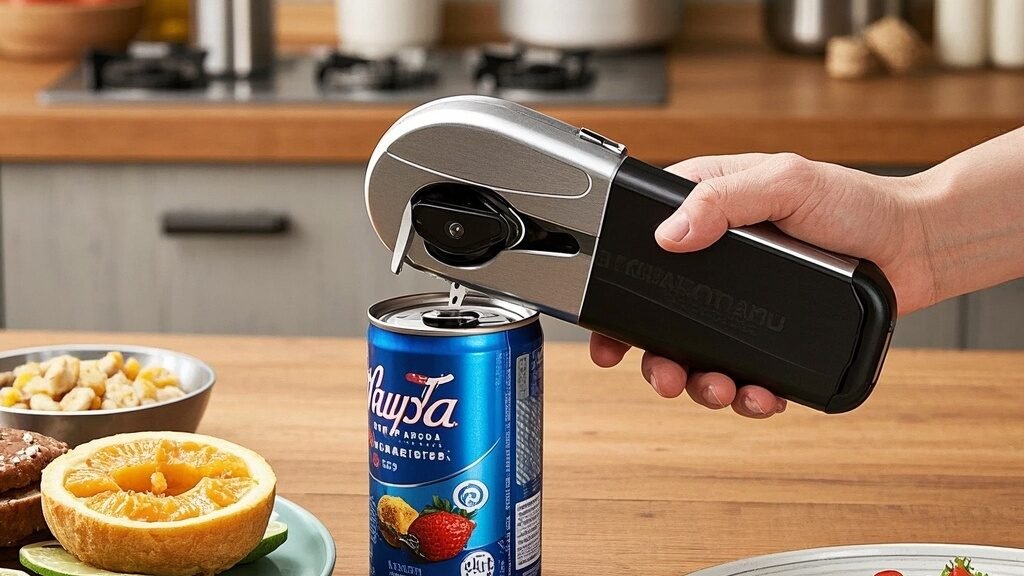
Do Safety Can Openers Really Prevent Sharp Edges?
Imagine this: you’ve just finished preparing a hearty chili. As you go to clean up, you reach into the sink and—ouch! A familiar, sharp sting. You’ve been nicked by the jagged lid of the can you opened earlier. It’s a minor kitchen injury, but it’s a reminder of a hidden, everyday hazard. For decades, the traditional can opener has left behind a treacherous, serrated edge, a design flaw we’ve all accepted as a necessary evil. But a new category of kitchen tools promises to change that, leading many to ask: Do safety can openers really prevent sharp edges? The answer isn’t just a simple yes; it’s a fascinating look at how a humble tool has been re-engineered for genuine safety.
How Traditional Openers Create the Problem
To understand the solution, we need to see the problem. A standard swing-arm can opener works by piercing the lid and then cutting through the metal seam around the top of the can. The cutting wheel shears the metal from above, pressing the severed lid down and leaving its raw, cut edge pointing outward. This edge is often razor-sharp and uneven. When you remove the lid, you’re handling a small, flexible disc of metal with a dangerously keen perimeter. Even discarded in the sink, it poses a cut risk. This design prioritizes mechanical simplicity and low cost over user safety, a trade-off we’ve lived with because, until recently, there was no mainstream alternative.
The Mechanics of a Safer Cut
So, how does a safety can opener differ? Instead of cutting from above, most safety models operate from the side. They use a different mechanism that slices through the seam *underneath* the lid’s rim. The key innovation is where the cut is made. By cutting from below, the opener leaves the lid’s edge smooth and safely tucked under the rim of the can. The separated lid itself often has a rolled, blunt edge. In our testing of several popular safety models, the result was consistently a lid that felt smooth to the touch—no microscopic, jagged teeth. According to manufacturers, this is often called a “smooth-edge” or “side-cutting” technology. The can’s body is also left with a smooth rim, eliminating the danger when washing or handling the empty can.
Performance and Real-World Use
Of course, a tool must do its primary job well. Safety can openers excel at eliminating sharp edges, but are they as efficient? Generally, they require a slightly different technique: you clamp them onto the side of the can rather than the top. They can be marginally slower and may require more hand strength for the initial puncture. Some users note they don’t work as well on unusually thick or odd-shaped cans. However, for standard soup, vegetable, or tuna cans, they are perfectly effective. The trade-off is clear: you might spend an extra two seconds turning the knob, but you gain peace of mind and tangible safety, especially in households with children, seniors, or anyone with dexterity concerns. The lack of a sharp edge also makes lid disposal safer and recycling easier.
Beyond the Edge: Additional Safety and Design Features
The safety focus often extends beyond just the cutting mechanism. Many of these openers feature ergonomic, non-slip handles that are easier to grip, reducing slippage—a common cause of mishaps with traditional openers. They also frequently design the tool to leave no small, detachable metal pieces (like the lid’s center in some old-style openers), which can be a choking hazard. Furthermore, the smooth-edge cut means the lid can often be placed back on the can for storage, keeping contents fresher in the refrigerator. It’s a holistic approach to rethinking a classic tool, where the primary benefit drives other useful improvements.
There’s undeniable proof in the pudding—or, in this case, in the smooth rim of a tomato can. Safety can openers do precisely what they advertise: they prevent the creation of sharp edges by fundamentally altering where and how the cut is made. While they may demand a small adjustment in technique and aren’t infallible on every single can type, their core promise is valid and impactful. They transform a daily task from a minor hazard into a genuinely safe activity. It’s a small upgrade to your kitchen drawer that represents a significant leap in thoughtful, user-centered design.
Who Should Consider a Safety Can Opener?
Virtually any household can benefit from the added security. They are particularly valuable for families with young children who help in the kitchen or rummage in recycling, for individuals with arthritis or reduced grip strength who are more vulnerable to slips, and for anyone simply tired of the occasional, surprising cut. If you prioritize safety and convenience over sheer, decades-old familiarity, making the switch is a smart, one-time decision.
Ready to banish sharp edges from your kitchen for good? Find the perfect can opener for your needs below!
Related Guides:
- Best Rated Can Openers 2026 (All Categories)
- Best Can Opener for Seniors with Weak Grip (2026 Top Picks)
- Best Can Opener for Arthritis Patients (2026 Pain-Free Picks)
- Best Can Opener for Stroke Survivors (2026 Easy-Use Picks)
- Best Electric Can Opener (2026 Top-Rated Automatic Models)
- Best Hands-Free Can Opener (2026 No-Grip Effort Models)
- Best Manual Can Opener (2026 Ergonomic Low-Effort Models)
- Best Sharp-Edge-Free Can Opener (2026 Safe No-Cut Models)