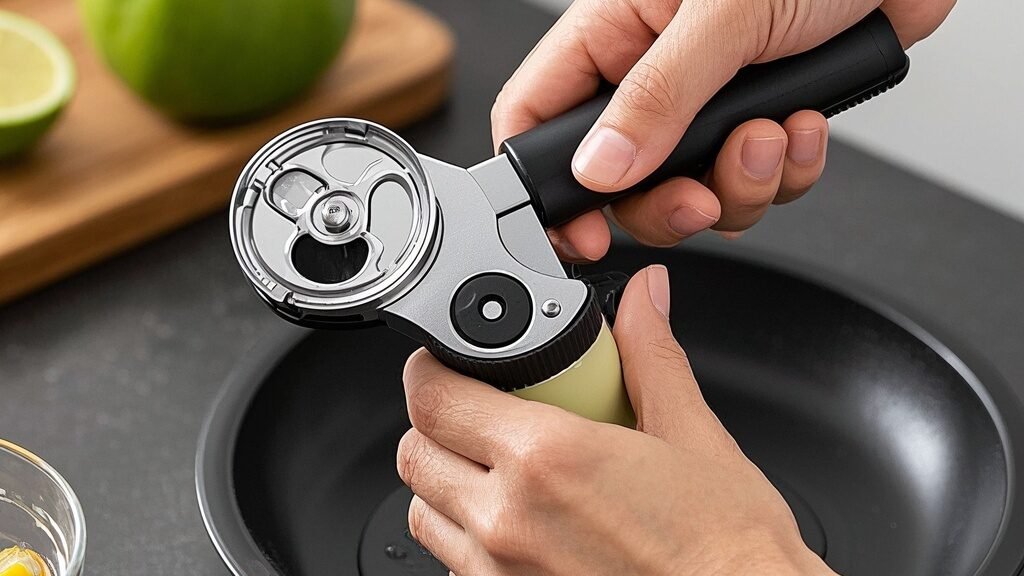
Ever stared at a stubborn can of soup, wrestling with a manual opener and wishing for a little kitchen magic? You’re not alone. The automatic can opener is one of those humble appliances that feels almost miraculous in its simplicity, saving our wrists and our patience with the push of a button. But have you ever stopped to wonder what’s actually going on under that plastic hood? Let’s crack it open and take a look.
At its core, an automatic can opener’s job is straightforward: it needs to cleanly cut through the metal lid of a can without damaging the rim or letting any metal shavings fall into your food. To do this, most modern electric models use a clever, two-part mechanical system. When you place a can onto the base and lower the cutting assembly, a small, serrated cutting wheel is positioned to press against the inside edge of the can’s rim. Simultaneously, a toothed drive wheel (or magnet) grips the outer side of the rim. Once you press the button, a small electric motor springs to life.
This is where the real action happens. The motor turns a set of gears that rotate the drive wheel. As this wheel turns, it grips the can’s rim and spins the entire can in a smooth, continuous circle. The stationary cutting wheel, pressed firmly against the metal, neatly slices through the lid as the can rotates. Think of it like a key cutting machine or a precision lathe, but for your baked beans. This rotating-can method is key—it ensures a clean, consistent cut all the way around with minimal effort from you. Some higher-end models go a step further, using a strong magnet to lift and hold the cut lid away from the food once the cycle is complete, a nifty feature that keeps sharp edges at bay.
So, what brings this whole process to life? It all comes down to a bit of electrical ingenuity. Inside the housing, a simple DC motor converts electrical energy from your wall outlet (via a power adapter) into rotational motion. This motor isn’t particularly powerful, but it doesn’t need to be. The gearbox attached to it is the unsung hero. It takes the motor’s fast, weak rotation and trades that speed for torque—the twisting force needed to turn a heavy, full can. This gearing-down process provides the steady, powerful spin that makes the cut effortless. A simple on/off switch, and sometimes a lever to raise and lower the cutter head, completes the user’s control. Safety features, like auto-shutoff mechanisms that trigger when the cut is complete, are common to prevent the motor from burning out.
From clunky countertop models of the mid-20th century to today’s sleek, cordless, and even battery-operated designs, the automatic can opener has evolved to become a fixture in the American kitchen. It embodies a classic principle of good design: taking a mundane, slightly annoying task and automating it with reliable, mechanical simplicity. It’s not rocket science, but it’s a perfect little example of practical engineering.
Next time you effortlessly open a can of tomatoes for your famous chili, take a second to appreciate the quiet whir of that little motor. It’s a small testament to the idea that the best tools don’t just get the job done—they get it done so well we almost forget they’re there. Now, who’s ready to cook?
Related Guides:
- Best Rated Can Openers 2026 (All Categories)
- Best Can Opener for Seniors with Weak Grip (2026 Top Picks)
- Best Can Opener for Arthritis Patients (2026 Pain-Free Picks)
- Best Can Opener for Stroke Survivors (2026 Easy-Use Picks)
- Best Electric Can Opener (2026 Top-Rated Automatic Models)
- Best Hands-Free Can Opener (2026 No-Grip Effort Models)
- Best Manual Can Opener (2026 Ergonomic Low-Effort Models)
- Best Sharp-Edge-Free Can Opener (2026 Safe No-Cut Models)