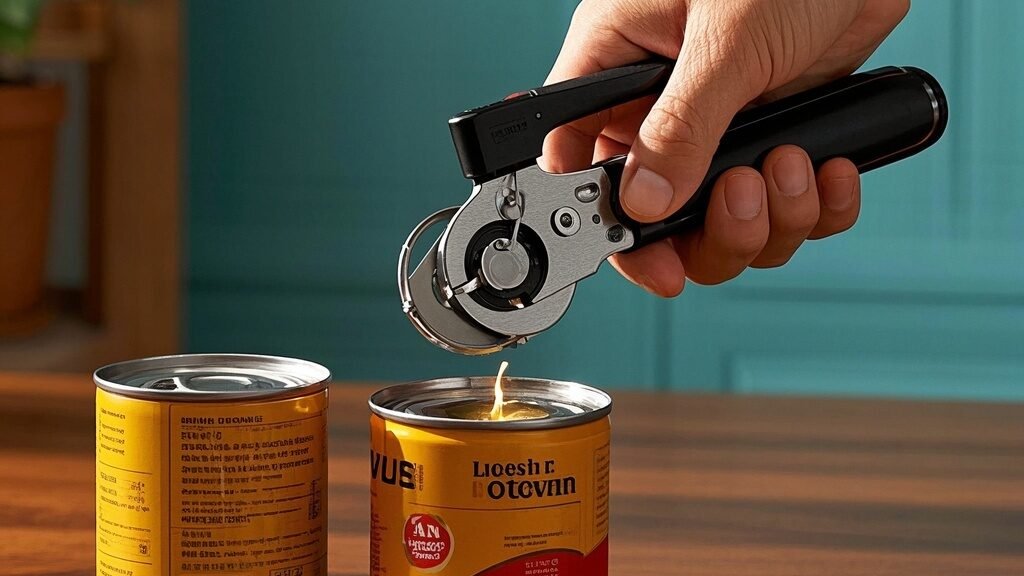
Is a crank-style manual can opener easier than a lever-style?
You’re standing in the kitchen, a can of beans in one hand and two simple tools on the counter: a classic crank-style can opener and a modern lever-style one. The question isn’t just about opening a can; it’s about which tool turns a mundane task into an effortless moment. For decades, the manual can opener has been a kitchen staple, but the evolution from the traditional turning crank to the innovative push-lever design promises a revolution in ease and safety. This brings us to the core dilemma many home cooks face: Is a crank-style manual can opener truly easier than a lever-style?
Understanding the Mechanics and User Experience
At their heart, both are manual openers, meaning they rely on your physical effort rather than a motor. The fundamental difference lies in how that effort is applied. The crank-style, or side-winding opener, operates with a familiar turning motion. You grip its two handles to clamp onto the can’s rim, then rotate a small knob or key to drive a cutting wheel around the perimeter. This design is straightforward and has proven reliable for generations.
However, this very motion can be its downfall in terms of ease. The action requires sustained rotational force and a firm grip, which can be challenging for individuals with arthritis, weaker wrists, or simply after a long day. It demands coordination between clamping pressure and turning. In contrast, the lever-style opener, often called a smooth-edge or side-cutting opener, reimagines the process. Instead of turning a knob, you repeatedly press a large lever. This press-down action engages gears that smoothly drive the cutting wheel around the outside of the can’s rim, not the inside. This mechanism often requires less continuous grip strength and can feel more intuitive, as the powerful lever does the heavy lifting, translating a simple push into precise cutting force.
Evaluating Effort, Safety, and Results
When judging ease, physical demand is a primary factor. For many users, especially those with hand strength limitations, the lever action can feel significantly less strenuous than the repetitive wrist rotation needed for a crank. The lever’s design often incorporates longer, ergonomically cushioned handles that fit comfortably in the palm, distributing force more evenly. A key advantage of the lever-style’s external cutting method is safety. It leaves no sharp, jagged metal edges on the can or the detached lid, a common hazard with traditional cutters that slice inside the rim. The resulting lid is smooth and can even be placed back on the can for storage in the refrigerator—a convenient feature crank-style openers typically lack.
That said, crank-style openers have their merits. They are generally more compact, less expensive, and their simple mechanism has fewer moving parts that could potentially jam or break. For someone with good dexterity and grip strength, the crank can be quick and efficient. The initial learning curve for the lever-style’s side-winding placement might also take a try or two to master, whereas most people are already familiar with the basic crank operation.
Making the Right Choice for Your Kitchen
So, which one is easier? The answer isn’t universal; it depends on your personal needs and physical comfort. The lever-style opener generally offers superior ease for those who prioritize minimal effort, enhanced safety, and added convenience features like resealable lids. Its ergonomic design is frequently recommended for seniors or anyone with joint pain. The crank-style opener remains a champion of simplicity, affordability, and reliability for users who don’t mind a bit more wrist action and value a classic, straightforward tool.
Who Should Consider a Lever-Style Can Opener?
If you struggle with grip strength, have arthritis, or simply want the safest, most effortless manual opening experience with bonus convenience, a lever-style can opener is likely your best bet. For those on a tight budget, with ample hand strength, and who prefer ultra-simple tools, a well-built crank-style opener will continue to serve faithfully. Assess your priorities—whether it’s cutting-edge ease and safety or timeless simplicity—and you’ll find the perfect tool to make opening cans a truly seamless task.
Find the perfect can opener for your needs below
Related Guides:
- Best Rated Can Openers 2026 (All Categories)
- Best Can Opener for Seniors with Weak Grip (2026 Top Picks)
- Best Can Opener for Arthritis Patients (2026 Pain-Free Picks)
- Best Can Opener for Stroke Survivors (2026 Easy-Use Picks)
- Best Electric Can Opener (2026 Top-Rated Automatic Models)
- Best Hands-Free Can Opener (2026 No-Grip Effort Models)
- Best Manual Can Opener (2026 Ergonomic Low-Effort Models)
- Best Sharp-Edge-Free Can Opener (2026 Safe No-Cut Models)