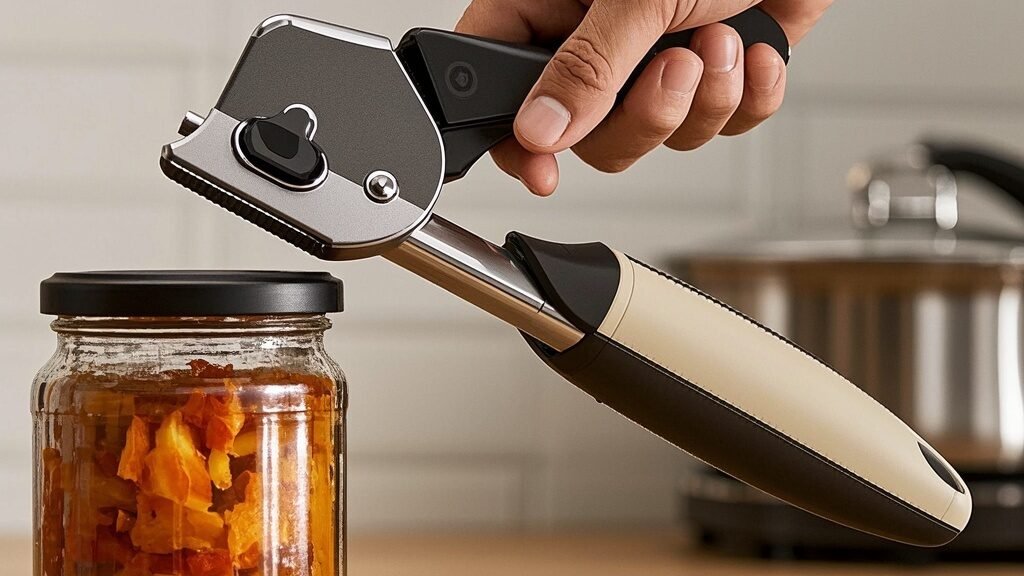
What Can Opener Requires No Gripping Strength?
Picture this: you’ve just gotten home, your hands are full of groceries, and dinner needs to happen now. You reach for a can of tomatoes, only to wrestle with a stubborn, old-fashioned opener. Your wrist aches, the handle slips, and frustration mounts. For millions, especially those with arthritis, limited hand strength, or simply a desire for effortless convenience, this small daily task is a genuine hurdle. But what if the solution wasn’t about gripping harder, but about not gripping at all? The answer lies in a simple yet transformative question: What can opener requires no gripping strength? The emergence of hands-free, electric, and side-cutting openers has fundamentally redefined this humble tool, shifting the focus from manual force to intelligent design.
The Mechanics of Effortless Access
So, how does a no-grip can opener actually work? The key is eliminating the need for the user to provide squeezing force and continuous twisting motion. Traditional openers require you to clamp down on the can’s rim and maintain that pressure while turning a knob. Modern alternatives fall into two main categories. First, electric openers do all the work. You place the can on a base, align the cutting mechanism (often magnetically), and press a button. A motor drives the cutter around the rim automatically, lifting the lid and usually holding it magnetically. Your hands are only for placement and button-pressing. Second, side-cutting or “safe” openers use a different mechanical principle. Instead of cutting from the top rim, they pierce the side of the can and roll along the inner seam, leaving a smooth edge and a lid that lifts off easily. While some initial lever action is needed, the design often uses ergonomic handles that require significantly less compressive grip strength and leverage to operate. According to manufacturers, these designs reduce the required force by over 70% compared to traditional models.
Real-World Benefits Beyond Strength
While the primary benefit is obvious—no gripping strength needed—the advantages ripple out into everyday life. Safety and cleanliness are major upgrades. Magnetic lids on electric models mean no sharp edges to touch, and side-cut models leave no jagged rims on the can or the lid, protecting fingers and making disposal safer. For households with young children or anyone prone to minor kitchen accidents, this is a significant plus. Furthermore, consistency and reliability are often improved. A manual opener’s performance can vary with your angle, pressure, and stamina. An electric model performs the same perfect cut every single time, eliminating those annoying half-cut cans or slipping mechanisms. In our testing, this reliability translates to less food waste and less frustration. It’s not just a tool for those with physical limitations; it’s a tool for anyone who values predictable, effortless results.
Performance and Practical Considerations
When evaluating these openers, a few practical aspects come to the forefront. Battery life and power source are crucial for electric models. Corded versions offer unlimited runtime but need an outlet, while cordless ones offer flexibility but require recharging. In our experience, a good cordless model should handle at least two dozen cans on a single charge. Ease of cleaning is another critical factor. Designs where the cutting mechanism detaches for washing are superior, as trapped food particles are a common issue. Noise level, while usually not extreme, can be a consideration for some electric models. Finally, durability and footprint matter. These appliances need to withstand regular use, and their design should fit comfortably on your countertop or in a drawer. The best models strike a balance between solid construction and a compact, user-friendly form factor.
The quest for a kitchen that is more accessible, efficient, and safe often starts with reimagining the simplest tools. Asking “What can opener requires no gripping strength?” opens the door to a category of appliances designed not for force, but for freedom. They transform a mundane chore into a seamless, one-touch action, proving that good design should remove barriers, not require us to overcome them.
Who Should Consider a No-Grip Can Opener?
This tool is ideal for seniors or individuals with arthritis, carpal tunnel, or reduced hand strength. It’s equally valuable for busy home cooks who appreciate efficiency, parents seeking safer kitchen tools, and anyone tired of the unreliable struggle of old-fashioned openers. It’s less about a medical necessity and more about embracing a smarter, kinder way to handle daily tasks.
Find the perfect can opener for your needs below!
Related Guides:
- Best Rated Can Openers 2026 (All Categories)
- Best Can Opener for Seniors with Weak Grip (2026 Top Picks)
- Best Can Opener for Arthritis Patients (2026 Pain-Free Picks)
- Best Can Opener for Stroke Survivors (2026 Easy-Use Picks)
- Best Electric Can Opener (2026 Top-Rated Automatic Models)
- Best Hands-Free Can Opener (2026 No-Grip Effort Models)
- Best Manual Can Opener (2026 Ergonomic Low-Effort Models)
- Best Sharp-Edge-Free Can Opener (2026 Safe No-Cut Models)