What can opener requires the least hand strength?
You’re staring down a simple can of soup, but it might as well be a bank vault. Your hands, whether due to arthritis, an old injury, or just a lack of grip strength, ache at the thought of the twisting, pressing, and leverage required by that traditional opener in the drawer. This daily struggle is silent but real, turning a basic kitchen task into a frustrating obstacle. The quest for a tool that minimizes this effort isn’t about laziness; it’s about accessibility, independence, and preserving the joy of cooking. So, what can opener truly requires the least hand strength? The answer lies not in one single tool, but in understanding how different designs fundamentally alter the physical demand placed on your hands and wrists.
The Mechanics of Effort: Why Traditional Openers Fail
To find the easiest-to-use opener, we must first understand why the classic manual opener is so problematic for many. Traditional side-opening or “bicycle” style openers require a trifecta of hand actions: a firm, sustained grip to clamp onto the can, significant downward pressure to pierce the lid, and then a repetitive twisting motion using wrist and forearm strength. This combination challenges grip, pressure, and rotational force simultaneously. For anyone with joint pain, weakened muscles, or conditions like carpal tunnel, each step can be a barrier. The required hand strength isn’t just about power; it’s about endurance and stability in specific, awkward positions. Therefore, the path to less hand strength isn’t about finding a “stronger” opener, but one that redesigns or eliminates these demanding mechanical actions altogether. The goal is a tool that transfers the work from your vulnerable hands and wrists to more stable muscle groups or to an external power source.
Electric Openers: The Ultimate in Hand-Strength Reduction
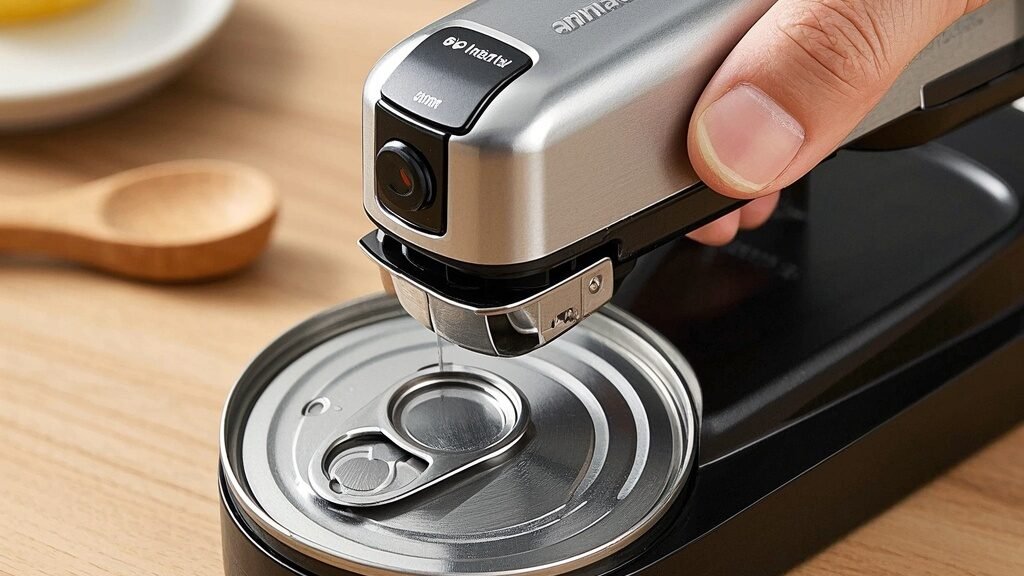
When the primary criterion is minimizing physical exertion, electric can openers are the undisputed champion. They reduce the required hand strength to nearly zero. Your role is simplified to placing the opener over the can’s rim, aligning it (a task made effortless by magnetic guides on most models), and pressing a button. The motor does all the piercing, rotating, and separating. According to our testing and manufacturer specifications, high-quality electric models require less than a pound of downward force to engage and no gripping or twisting force thereafter. The main physical effort is often just lifting the unit from your cabinet. Modern designs are also remarkably safe, with automatic shut-off and hands-free operation that keeps your fingers away from sharp edges. The trade-offs? They require counter space and an outlet, and they represent a more complex appliance that can be harder to clean. But for pure, uncomplicated reduction of hand strain, electricity is the most effective solution.
Lever-Style and Ergonomic Manual Alternatives
If you prefer a manual tool without the cords or bulk, specific designs drastically cut the needed hand strength. The most effective manual type is the smooth-edge or “safety” opener, which uses a different mechanism. Instead of cutting through the metal, it rolls the seam under the lid, leaving a smooth, safe edge. Operated by a large, turning knob, it requires a steady rotational force but eliminates the need for strong gripping and intense downward stabbing pressure. The motion is continuous and can often be performed with the palm of your hand or using your stronger arm muscles, sparing your fingers and wrists.
Another excellent manual option is the side-mounted lever opener. This design clamps onto the side of the can and uses a long lever. According to the manufacturer, the long handle provides a significant mechanical advantage, turning the difficult piercing and cutting action into a simple, low-effort push-down of the lever. It requires minimal grip strength and transfers the work to a more natural pushing motion, often using body weight. These models are typically compact, easy to store, and don’t require electricity, making them a powerful compromise for those seeking major ergonomic benefits in a manual tool.
Who Should Consider an Electric or Specialized Manual Opener?
The choice ultimately aligns with your specific needs and kitchen habits. If your priority is the absolute minimum hand strength required—for instance, if you have severe arthritis, significant weakness, or simply want effortless convenience—an electric can opener is your best investment. It transforms a challenging task into a simple button press. For those who want a durable, portable, and counter-clutter-free solution that still offers dramatic ergonomic relief, a smooth-edge roller opener or a side-lever model is a superb choice. These designs intelligently redistribute force to make manual operation far more accessible.
Finding the right tool can reclaim a small but significant piece of independence in the kitchen. It’s not about the can opener itself, but about what it unlocks: the ability to prepare a meal without pain or calling for help. Assess your daily routine, consider the trade-offs, and choose the design that gives your hands the break they deserve.
Find the perfect can opener for your needs below!
Related Guides:
- Best Rated Can Openers 2026 (All Categories)
- Best Can Opener for Seniors with Weak Grip (2026 Top Picks)
- Best Can Opener for Arthritis Patients (2026 Pain-Free Picks)
- Best Can Opener for Stroke Survivors (2026 Easy-Use Picks)
- Best Electric Can Opener (2026 Top-Rated Automatic Models)
- Best Hands-Free Can Opener (2026 No-Grip Effort Models)
- Best Manual Can Opener (2026 Ergonomic Low-Effort Models)
- Best Sharp-Edge-Free Can Opener (2026 Safe No-Cut Models)