What kitchen tools help seniors with weak hands?
The rhythm of the kitchen—the chop of a knife, the twist of a jar lid, the steady pour from a pot—is a melody of independence. But for many seniors, arthritis, diminished grip strength, or conditions like Parkinson’s can turn this familiar symphony into a frustrating challenge. A simple task like peeling a potato or opening a can becomes a daunting obstacle, quietly chipping away at the joy and autonomy of preparing a meal. The good news is that the right kitchen tools for seniors with weak hands are not just about convenience; they are powerful keys to reclaiming confidence and safety at the heart of the home. Modern assistive kitchen tools are thoughtfully designed to reduce strain, minimize effort, and put the pleasure of cooking back within comfortable reach.
Ergonomic Handles and Leverage-Based Tools
The foundation of a hand-friendly kitchen starts with grip. Standard tools often have thin, hard handles that require tight pinching, which is precisely what weak hands struggle with. The solution lies in ergonomic design. Look for tools with large, soft, non-slip handles that distribute pressure across the palm rather than concentrating it on the fingers. These handles are often oval or contoured to fit the hand’s natural shape. Beyond handles, the principle of leverage is a game-changer. Rocker knives, for example, use a curved blade that allows the user to cut with a gentle rocking motion, using the weight of the knife and body leverage instead of forceful downward pressure. Similarly, jar openers that mount under a cabinet provide immense mechanical advantage, turning a wrist-twisting struggle into an easy pull-down lever action. Investing in these core items transforms basic prep from a painful chore into a manageable activity.
Power and Automation for Maximum Ease
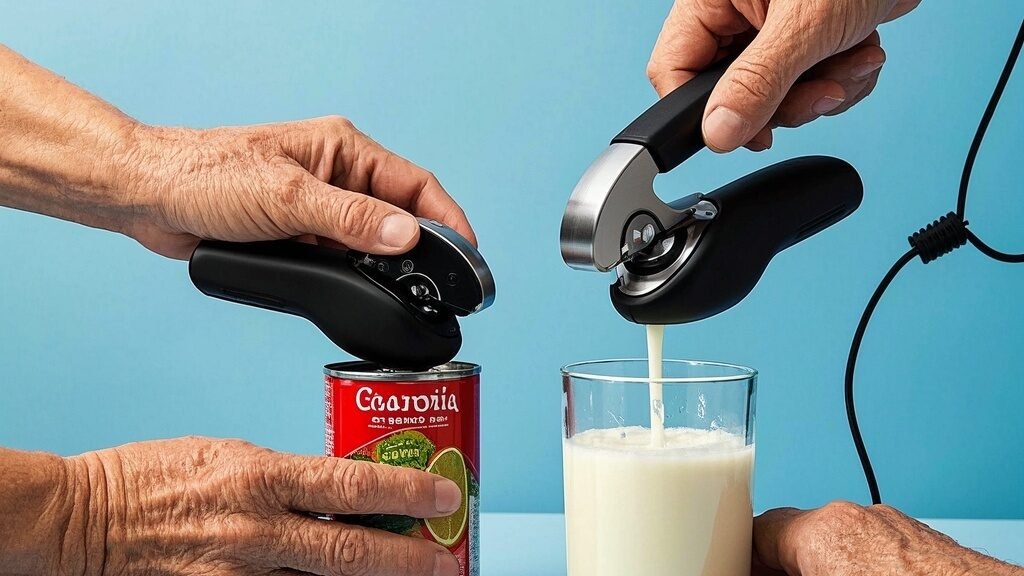
Where ergonomics meet innovation, power-assisted tools take over the heaviest tasks. Electric can openers are perhaps the most iconic example, requiring only the push of a button to magnetically lift the lid away, eliminating sharp edges and hand-cranking entirely. For those who love fresh vegetables but dread the peeling, automatic peelers that hold the vegetable and rotate it against a blade are revolutionary. Another standout is the one-touch electric jar opener. Simply place the jar on the base, press down, and the device does all the twisting for you. These tools are not about laziness; they are about energy conservation. They allow seniors to complete tasks that would otherwise be impossible or unsafe, preserving their strength for the creative and enjoyable aspects of cooking. When selecting powered tools, prioritize models with large, clearly labeled buttons and non-slip bases for stability.
Safety and Stability to Prevent Accidents
Weak hands often come with concerns about tremors or sudden loss of grip, making safety paramount. Stability-enhancing tools are crucial. Non-slip cutting boards that suction to the countertop or have silicone edges prevent dangerous slipping during chopping. Similarly, bowl holders and stabilizing mats keep mixing bowls firmly in place with one-handed use. Pouring can be a major hazard; consider lightweight pitchers with easy-grip handles and pour spouts designed to control flow, or use a two-handled pot for better balance when transferring liquids. Tools like kettle tippers safely pour boiling water from a stable base, and stove knob turners with extended handles provide better control without requiring a tight pinch. This category is all about creating a secure environment, reducing the fear of spills or burns, and fostering the confidence to cook without anxiety.
Adaptive Aids for Everyday Tasks
Finally, don’t overlook the small, inexpensive adaptive aids that solve very specific problems. Button-style can openers that leave a smooth, safe lid edge are a simple upgrade. Tap turners—levers that fit over stubborn faucet handles—make them easy to operate. Lightweight, carbon steel knives with ergonomic handles require less force than dull, heavy knives. Pre-cut vegetables or using a food processor for initial chopping can drastically reduce prep time and hand fatigue. Even something as simple as a silicone jar opener pad can provide the extra grip needed for a stubborn lid. These adaptations are about auditing every step of a recipe and asking, “Where is the pinch, twist, or pressure point?” and then finding a clever tool to alleviate it.
Cooking is a fundamental life skill and a profound source of nourishment and joy. The right tools ensure that this vital activity remains accessible, safe, and enjoyable for seniors experiencing hand weakness. By focusing on ergonomics, leveraging technology for the toughest jobs, prioritizing safety, and implementing smart adaptations, the kitchen can once again become a place of creativity and independence, not frustration.
Who Should Consider These Adaptive Kitchen Tools?
These tools are ideal for seniors, or anyone of any age, dealing with arthritis, reduced grip strength, hand pain, tremors, or recovering from surgery. They are also wonderful gifts for aging parents or loved ones who value their independence but may be struggling silently with daily tasks. Ultimately, anyone who wants to make kitchen work safer, easier, and less physically demanding will benefit from this thoughtful category of tools.
Find the perfect tools to empower your or a loved one’s kitchen independence below!
Related Guides:
- Best Rated Can Openers 2026 (All Categories)
- Best Can Opener for Seniors with Weak Grip (2026 Top Picks)
- Best Can Opener for Arthritis Patients (2026 Pain-Free Picks)
- Best Can Opener for Stroke Survivors (2026 Easy-Use Picks)
- Best Electric Can Opener (2026 Top-Rated Automatic Models)
- Best Hands-Free Can Opener (2026 No-Grip Effort Models)
- Best Manual Can Opener (2026 Ergonomic Low-Effort Models)
- Best Sharp-Edge-Free Can Opener (2026 Safe No-Cut Models)